
Research at MAXAM
Exploring the molecular origins of light
MAXAM investigates the molecular origins of light in organic semiconductors.
Our research connects photophysics, kinetics, computational chemistry, molecular dynamics and OLED device physics to uncover how molecular-level processes determine macroscopic optoelectronic performance.
We are particularly interested in how organic molecules absorb energy, form excited states, undergo spin and energy conversion, and ultimately emit light.
By studying these processes across molecular, thin-film, and device scales, MAXAM aims to establish fundamental design principles for efficient, stable, and color-pure organic light-emitting materials.
Representative Research Achievements
MAXAM’s research direction is built upon representative studies that connect fundamental photophysics with practical OLED material design.
These works demonstrate our mechanism-driven approach to exciton dynamics, molecular design, and high-performance organic light-emitting systems.


Our Approach
MAXAM follows a mechanism-driven research framework. We identify the molecular and photophysical origins of device performance, translate these insights into predictive design principles, and apply them to the development of efficient and stable organic optoelectronic materials.
Our research begins with fundamental questions: how are excited states formed, how do they evolve, where are they lost, and how can they be controlled? These questions guide our analysis of molecular photophysics, exciton dynamics, computational prediction, and OLED device behavior.
Core Research Themes
Our research is organized around four interconnected themes that bridge molecular science, kinetics, computational design, and OLED device engineering.

Photophysics
MAXAM explores the photophysics of organic emitters by elucidating how excited states are generated, transformed, radiatively harvested, or lost through nonradiative decay.
We investigate how molecular structure and electronic configuration dictate essential emission characteristics, including emission wavelength, oscillator strength, excited-state lifetime, photoluminescence quantum yield, and color purity.
These insights provide the foundation for molecular design principles that enable efficient, stable, and precisely controlled light emission.
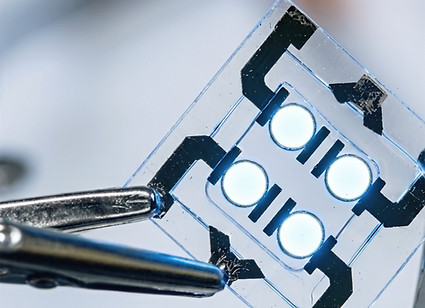
Device Physics & Engineering
OLED performance is not determined by molecular properties alone, but by how excited states behave within the full device architecture.
MAXAM investigates charge transport, exciton distribution, recombination-zone engineering, and optical-mode control in OLEDs, with particular emphasis on optical interference, Purcell effects, surface plasmon polariton coupling, and light extraction.
By connecting molecular excited-state behavior with device physics and optical engineering, we aim to develop OLED architectures that deliver efficient, stable, and precisely controlled light emission.

Exciton Dynamics
Exciton dynamics defines how light-emitting systems perform, degrade, and ultimately reach their operational limits.
MAXAM investigates how excitons are generated, converted, transported, and dissipated in organic emitters and thin films, with particular emphasis on singlet–triplet interconversion, exciton diffusion, exciton–exciton annihilation, and nonradiative loss channels.
By tracing the full lifecycle of excitons, from formation to radiative emission or loss, we seek to uncover the microscopic origins of efficiency roll-off and develop molecular and device-level strategies for exciton control.

Computational Molecular Design
Molecular discovery becomes powerful when physical understanding and computational prediction work together.
MAXAM integrates quantum chemistry, molecular dynamics, and machine-learning-based modeling to understand how molecular structure, electronic configuration, conformation, and intermolecular interactions govern the photophysical and device-relevant properties of organic light-emitting materials.
Through this approach, we aim to accelerate the discovery of efficient, stable, and color-pure organic emitters and establish rational design principles for next-generation OLED materials.
Toward Next-Generation Organic Optoelectronics
By connecting molecular photophysics, exciton dynamics, computational design, and OLED device engineering, MAXAM aims to create a research platform where fundamental understanding leads directly to advanced organic light-emitting materials and technologies.